Originally written January 28, 2026.
It was difficult to watch Interstellar without also thinking about Danny Boyle’s Sunshine (2007) and Stanley Kubrick’s 2001: A Space Odyssey (1968), but not necessarily in the sense that the three ought to be directly compared to each other. Rather, having recently revisited the other two I went into Interstellar with the mindset that outer space is an unknowable and existentially profound thing, its incomprehensible scale and emotional power acting as both a point of inspiration for adventure and a cause for mental fragmentation. In no other way can you ever be further away from everything that brings you comfort and familiarity than slinging yourself into deep space.
Interstellar tries to have it both ways. On the one hand, here is a story about a team of astronauts being sent through a wormhole to another galaxy entirely, hoping to find a habitable planet as the Earth slowly succumbs to an irreversible blight. On the other hand, this story keeps one foot firmly planted on Earth at all times as if afraid you might forget what’s at stake, before wrapping things back around in alarmingly predictable fashion. It is both an awe-inspiring rendering of some of the wildest features of the cosmos—hypothetical and otherwise—and a movie that’s determined to supply answers and tie a very neat bow on things.
I was let down by the Earthside part of Interstellar, with its archetypal single dad raising his kids on a classic American ranch, cracking a cold one on the porch and reminiscing with the old man about the glory days of the past. I half expected to see the Stars and Stripes aloft, flanked by a setting sun, a weathered baseball tossed back and forth between aged mitts. To be sure, it doesn’t reach fully into Fourth of July territory, and I was fond of the Dust Bowl inspirations that play into the opening scenes, interspersed with brief interview snippets of seniors describing the hard times way back when in a very Depression era-coded way. Don’t be fooled into thinking the film isn’t going to fit in a baseball game, however!
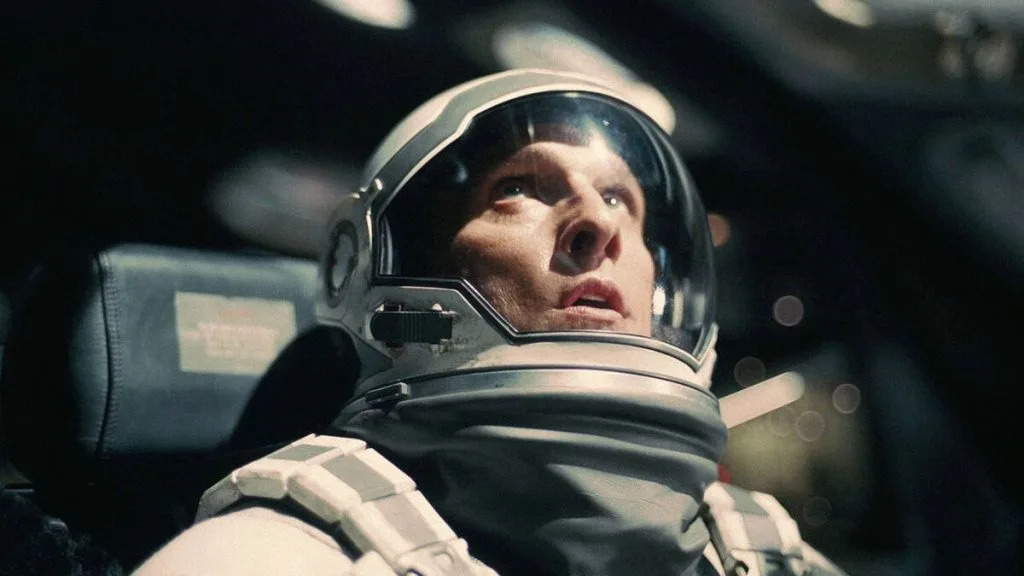
These portions of Interstellar, and the frequent revisiting of the kids of protagonist Cooper as they grow up, are not terrible, but they’re dwarfed by the awesome power of the voyage through the wormhole. Matthew McConaughey plays an almost comically gravelly hero character when he’s home, but once the expedition begins he really comes into his own as a talented ship pilot who wears grit and a sweaty determination on his sleeve. Joining him are Anne Hathaway, Wes Bentley and David Gyasi who put in decent enough performances, but it’s the anamorphic cinematography from Hoyte van Hoytema that really brings this crew and their mission to life. It’s a beautiful encompassing picture that fills your vision with the interior of the ship and the overwhelming scale of outer space. You know film stock? Every movie should be shot on it.
Matt Damon also appears at some point as a character I could only describe as Matt Damon, and his short-lived role ends in a way that really just nullifies whatever he may have added to this story. He brings a weird bit of drama that feels like it unfolds only because someone decided the pacing needed some kind of jolt.
The most harrowing thing that happens in Interstellar is time dilation, a terrific use of relativity (insofar as I understand it) that makes every step of the journey incredibly costly. A few hours spent on a planet in this faraway galaxy could mean decades passing on Earth, and this is when the real stakes of the mission are felt. The biggest threat isn’t aliens or even basic survival but wasting time, giving the mission an awfully intimidating pressure. Between this uniquely frightening complication and every scene just looking and sounding amazing (Hans Zimmer coming in again with another iconic dramatic score) it’s no wonder these are the best parts of the film.
 Notes from Nate
Leave a comment