It’s good to know that in the thirty-six years that elapsed between Perfect Days and the last Wim Wenders film I watched—that would be 1987’s Wings of Desire—the German filmmaker didn’t lose hold of the drive to film the quiet, contemplative side of human existence. While this third film in my Wim Wenders journey is unmistakably a product of the celebrated Paris, Texas (1984) director and the sensibilities that have guided him through these movies, the circumstances behind Perfect Days are quite different, Wenders having been invited to Japan to produce a short film promoting the construction of high-quality public restrooms in Shibuya.
Evidently Wenders saw something more in these facilities—together dubbed The Tokyo Toilet—to instead put together a feature-length film, and it’s not difficult to see why. The restrooms, designed by several architects of renown, are indeed quite beautiful and carry unique characteristics, such as the transparent facilities whose walls become opaque upon locking the doors. There was clear attention paid to not just the function but the aesthetics of each and how they might relate to their surroundings—the mushroom restrooms nestled among some trees are another highlight. The inspiring designs get the wheels turning: who maintains the quality of these facilities, and what might their day be like tending to these works of infrastructural art?
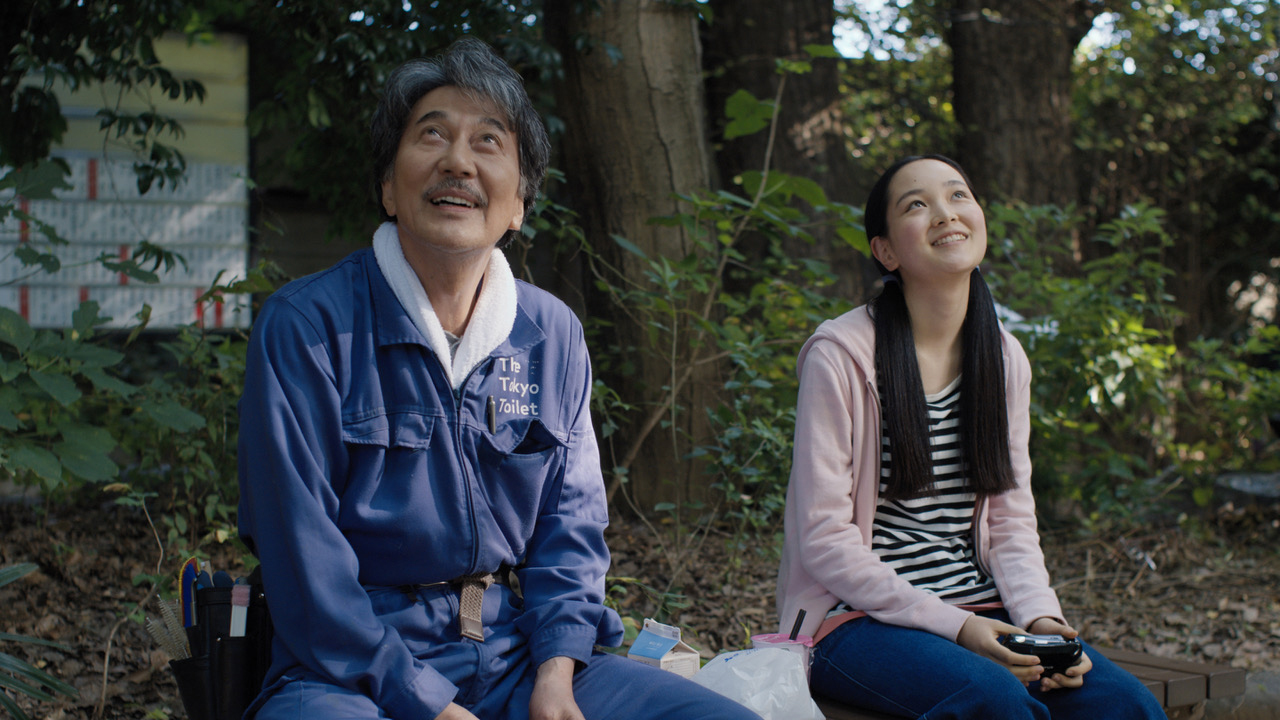
Hirayama is the guy, a man with some years behind him and a love for cassette tapes. Every day of his work week he dons a recognizable blue jumpsuit and navigates the city streets and highways of Tokyo in a blue van. At each facility he unloads his gear and chemicals and gets to work, picking up every bit of scrap and polishing every bit of surface. Every now and then someone enters to use the restroom, and Hirayama respectfully steps out—another chance to look up at the trees, a past time of his.
Notably, Hirayama glaces up at the leaves and tree branches above him every time he steps outside in the morning to go to work, and in his off-hours takes photographs of nature with a small film camera. Throughout the film Hirayama, gently portrayed by Koji Yakusho, wears a quiet pride and contentment on his face, happy to just be getting by and seemingly unbothered by much of anything. Something deeper within threatens to come out on a couple of occasions—one, when his outwardly wealthy sibling questions his career choice, and again after the fact when his face undergoes a series of emotions that never quite break out. Wenders never reveals Hirayama’s backstory in the film, opting instead for a very in-the-moment slice-of-life approach. The feeling that something is lingering there beneath the surface is thus left unexplained.
But it’s a real delight watching Hirayama do his thing. Franz Lustig’s cinematography, the sunny concrete beauty of urban Japan, and the closeness of the 4:3 aspect ratio make for a visually appealing film, especially when Hirayama is driving along a highway, camera pointed out the side window so we can see the van reflected back at us in the windows of the skyscrapers passing by. And bookending each day are brief dream sequences that offer fuzzy glimpses at the people and places occupying Hirayama’s sleeping mind, a distinct touch that offers a good bit of texture to his life.
Taking pleasure in the simple joys of life is the obvious message here, but the film also makes one long for a world where these sorts of projects—be they funded by entrepreneurs or non-profits or, get this, the government—were more commonplace. Why can’t we have better infrastructure and facilities that not only ease the burdens of life and preserve our dignity but that are also designed with an eye for the environment and human expression? In both The Tokyo Toilet and Hirayama I see the same thing: the potential for simple everyday moments to be great if we just make it so. Leave it to Wim Wenders to pull off another characteristically human story in an advertisement.
 Notes from Nate
Leave a comment