Originally written January 17, 2026.
One of the predominant themes running through the veins of Adolescence is about control—more specifically, a lack of control over ourselves, our friends and family, our community, and our narratives. Through each of the four breathlessly tense episodes of Adolescence we see people grappling with unseen forces that are tearing at the fabric of themselves and society in malicious ways and failing completely to control them.
It begins right away in Episode 1, with a heavily armed police force breaking down the door to a family home and arresting 13-year-old boy Jaime on suspicion of murdering a classmate. Right away the Miller family’s life is torn asunder, and no amount of begging and pleading can release Jaime from being detained and whisked away to a police station to be booked. We follow him all the way to the station and through processing, where he is escorted from step to step, probed by adults he doesn’t know for questions he can barely comprehend and blood samples he would much rather not give. I had already barely breathed by the time the investigators began asking Jaime directly about the case and the assembled evidence started to paint a damning picture.
It continues in Episode 2, where the two lead officers on the case investigate Jaime’s school and find the place in near disarray, the faculty having to struggle day-to-day to keep it’s student body in line while tensions simmer underneath the surface between peers. Fights break out, kids laugh at their phones and point at each other, every possible schoolyard anxiety coming to the fore in a cacophonous environment that seems ready to spill out beyond the school gates. The adults seem to be at their wits end, having to spend nearly as much time corralling and disciplining students as they do actually teaching. And then, in one of the more unsettling exchanges, one of the officers on the case has a private conversation with his son, who reveals the toxic social media manosphere poison and bullying that have taken root in the lives of these young people. From then on there is an inescapable feeling that something irreparably bad has taken place that likely no one has the capacity to solve.
Episode 3 takes us away from the school grounds to a one-on-one conversation between Jaime and a psychiatrist, there to evaluate his mental state for the judge on the case. The conversation begins cordially but soon descends into worse territory when questions regarding Jaime’s feelings about girls and his father cause him to fly off the handle, screaming and throwing things around the room. The scope of the murky, unresolved ideas about women banging around in this 13-year-old’s head becomes alarmingly clear. After each meltdown he manages to calm down, but all of these outbursts seem to overtake him like a boy possessed, totally unable to rein in or even understand his own rage.
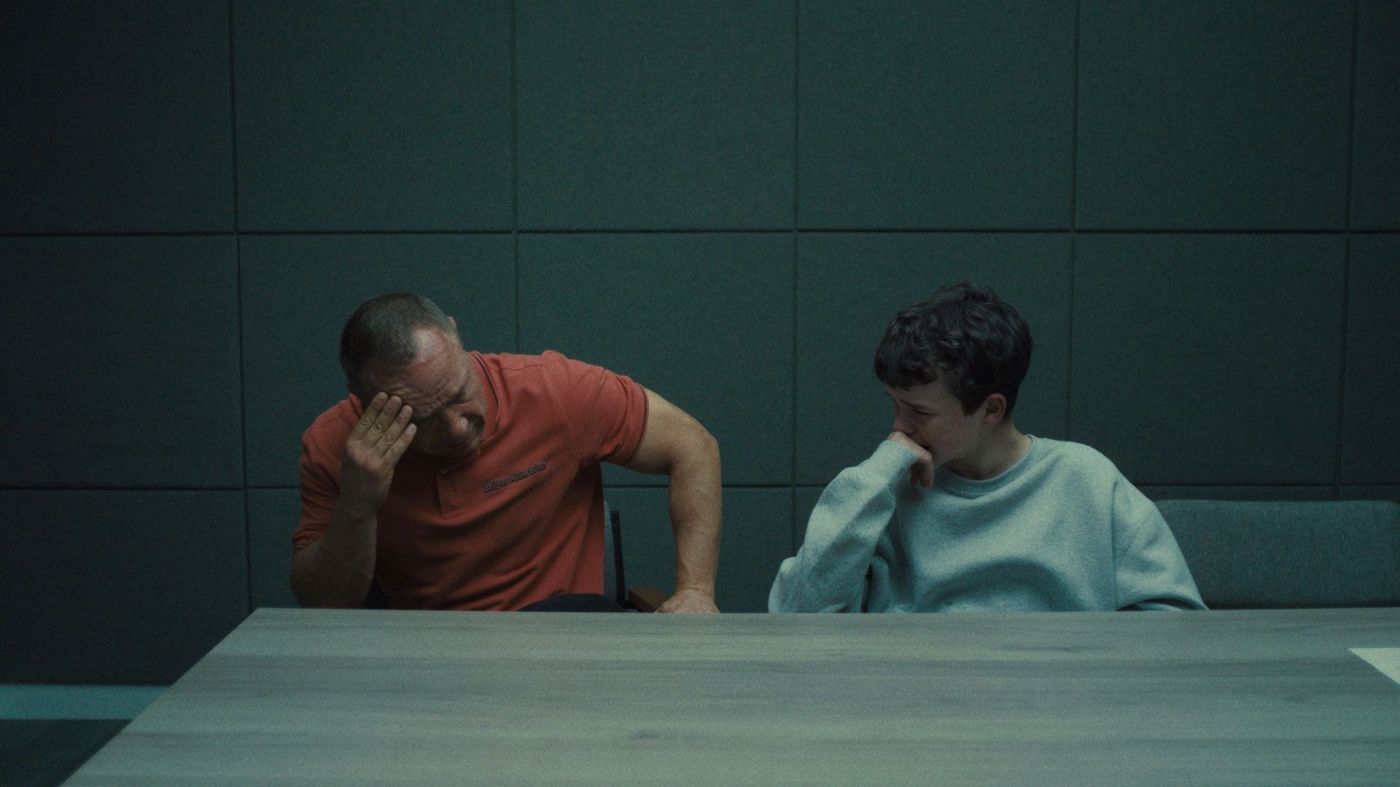
The final episode sees Jaime’s father barely holding it together over a year after the arrest, made worse by antagonism from his own community and his incredibly short temper with his own wife. In Mr. Miller we see an origin point for a lot of Jaime’s own behavior, including the sudden destructive shifts between a pleasant mood and virulent, blinding rage. Neither are able to control their own emotions, it seems, and the father carries an ultimately impossible desire to leave all of this behind through sheer will. Thankfully he does start to come to terms with what’s happened and his own role in it in the final scene, but by then it’s too late to reverse what’s been done.
Carrying each episode is the flawless one-shot filmmaking that really emphasizes the dread of events getting increasingly out of hand. It’s an incredibly well-grounded show that you simply cannot look away from and that expertly understands how far a suffocatingly immersive atmosphere can take a story, and that’s in addition to every meaningful thing it has to say about parental influence and the undercurrent of hate coursing through social media like a disease. These aren’t new ideas, but being rendered with this degree of asphyxiating precision makes them unavoidable in a way we could all benefit from, living as we are in a world that always seems to be spiraling in some undesirable direction or other.
 Notes from Nate
Leave a comment